.jpg?width=60)
The Problem
Modern security operations depend on shipping firewall, network, and system logs to external SIEM, XDR, and analytics platforms. Those platforms often run outside the customer’s security boundary—in a managed SOC, a cloud-native security service, or a third-party analytics environment.
That creates a familiar tension. Logs contain sensitive details: internal IP addresses, usernames, email addresses, hostnames, session identifiers, and free-text fields that can reveal business context. Sending them unprotected expands the attack surface and complicates compliance. Keeping them locked inside the perimeter limits detection, investigation, and response.
Organizations need a way to export the telemetry external services require—without handing over raw, unrestricted log data.
The Solution: Receive, Protect, and Redact at the Source
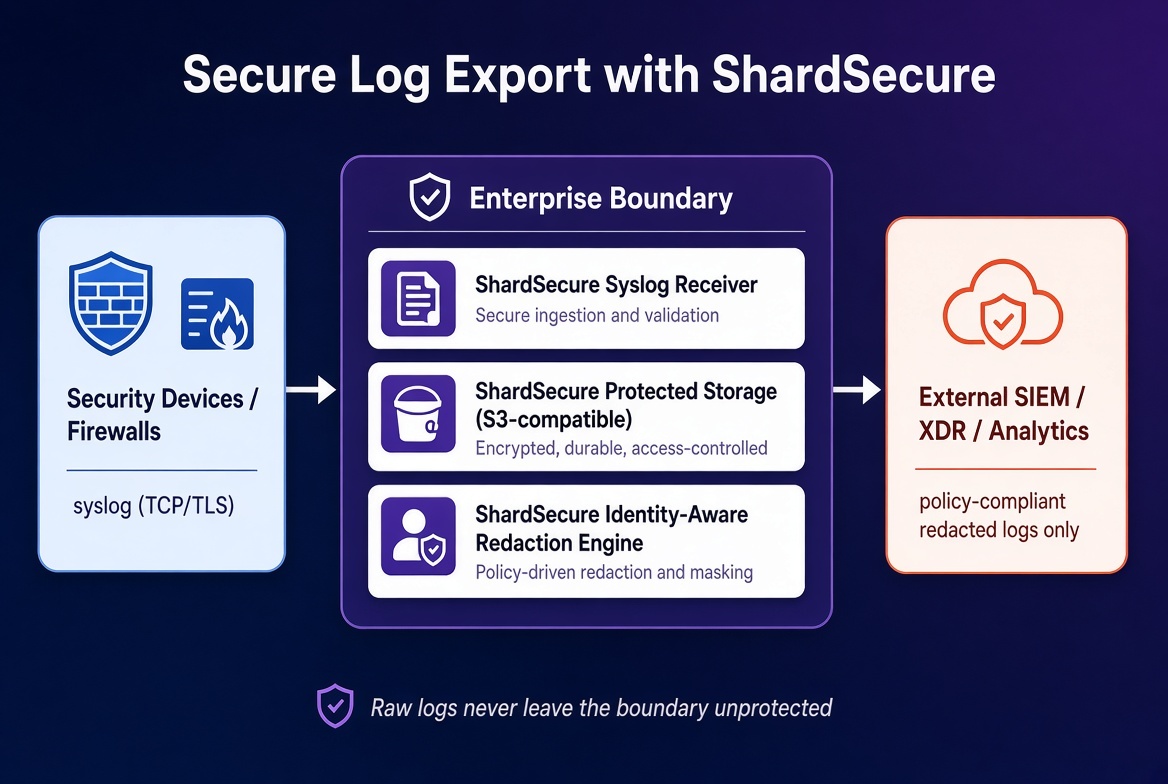
ShardSecure sits inside the enterprise boundary and becomes the controlled exit point for security logs. Devices send syslog directly to a built-in ShardSecure syslog receiver. Logs are stored under ShardSecure’s protection (encryption, fragmentation, and least-privilege access). Before any data is released to an external SIEM, XDR, or analytics service, the same identity-aware redaction engine used by ShardSecure MCP applies policy-driven masking and least-privilege fragment release.
Raw logs never leave the perimeter unprotected. Only policy-compliant, redacted content is delivered outside.
How It Works
- Firewalls, gateways, and other security devices send logs over syslog (TCP recommended; TLS where supported) to the ShardSecure syslog receiver inside the enterprise boundary.
- Received logs are written into ShardSecure-protected storage (S3-compatible). Data is encrypted and fragmented; access is governed by least-privilege controls and rich object-level metadata.
- When an external consumer needs logs, a processing identity authenticates to the ShardSecure redaction engine—the same identity-aware engine that powers the MCP Secure Gateway.
- The engine evaluates identity and policy, retrieves only the authorized data, and applies dynamic redaction (masking, tokenization, placeholders, last-four patterns, or consistent synthetic mapping as defined by policy).
- Only the sanitized, minimum-necessary log content is released to the external SIEM, XDR, or analytics service—via syslog, HTTPS, or object delivery, depending on the destination.
Because ingestion, storage, and redaction all occur inside the boundary, the organization retains full control over what leaves—and under which identity and policy it leaves.
Example Use Cases
- Managed SOC / MDR providers — A third-party SOC needs continuous firewall and network logs for detection and response. ShardSecure receives the syslog stream, protects it at rest, and releases only redacted, policy-compliant events so the provider can detect threats without unrestricted access to internal identities or infrastructure details.
- Cloud-native SIEM and XDR platforms — Security teams send normalized logs to a cloud SIEM or XDR for correlation and hunting. Before objects leave the boundary, the redaction engine enforces which fields (users, internal addresses, free-text notes) may be shared with that platform’s identity and role.
- Compliance and audit export — Regulators or auditors require evidence from a defined period. A controlled export identity requests the relevant log set; policies mask PII and sensitive internal context while preserving action, severity, timestamps, and external indicators needed for verification.
- Cross-border or multi-region analytics — Logs must support analytics in another region or jurisdiction. Sovereignty and classification policies ensure restricted fields never leave the approved boundary, while still enabling useful telemetry for the external service.
- Partner and MSSP sharing — Multiple business units or partners consume a shared security feed. Each consumer authenticates under its own identity; the redaction engine returns only the data and field visibility allowed for that partner—without maintaining separate masking pipelines per destination.
Key Benefits
- Built-in syslog receiver — No separate collector stack is required for basic ingest. Security devices send syslog directly to ShardSecure inside the boundary.
- Protected storage at rest — Logs benefit from encryption, data fragmentation, and least-privilege access before any external release is considered.
- Same redaction engine as MCP — Identity-aware policies, dynamic masking, and least-privilege fragment release are consistent with how ShardSecure secures data for AI agents and cloud models.
- True least privilege for export — External SIEM, XDR, and analytics services receive only what policy allows for the requesting identity—not full raw objects.
- Single policy plane — One set of policies and IdP integrations (Auth0, Okta, Ping, Keycloak, ForgeRock, or built-in) can govern both AI context enrichment and log export.
- Reduced compliance risk — Sensitive values are handled before data leaves the perimeter, simplifying data-protection and sovereignty requirements.
Why This Matters
As more detection, investigation, and analytics workloads move to external or cloud-hosted platforms, the volume of log data that must cross the enterprise boundary continues to grow. Without a controlled exit path, organizations face a choice between over-sharing sensitive telemetry and under-feeding the tools that protect them.
ShardSecure closes that gap. By combining a native syslog receiver, protected storage, and the same identity-aware redaction engine used for secure AI access, it lets security logs leave the premises only in the form—and under the policies—the business has approved.
External services get the visibility they need. The enterprise keeps control of the data.
Evaluation / POC
ShardSecure is available for no-cost evaluation by enterprise customers and partners. Contact us at info@shardsecure.com to schedule a technical briefing or proof-of-concept focused on secure log export to your SIEM, XDR, or analytics providers.
Ready to export security logs without exporting risk?
Contact info@shardsecure.com for a no-cost evaluation.