.jpg?width=60)
The Problem
Cloud AI models and agents need enterprise data to deliver real value. That data, however, usually lives inside the customer’s security boundary—on-premises systems, private cloud stores, and internal databases that should never be broadly exposed.
Traditional approaches force a difficult trade-off: open network paths and risk leakage, or keep the data locked away and limit what AI can do. Neither option is acceptable for most organizations.
The Solution: Controlled Access at the Source
ShardSecure MCP is deployed inside the enterprise boundary. Cloud AI models and agents connect to the MCP server. The MCP then retrieves only the specific data the requesting identity and agent are allowed to see—after applying dynamic redaction where needed.
Sensitive information never leaves the perimeter in raw form. Only identity-aware, least-privilege, redacted data enters the model context.
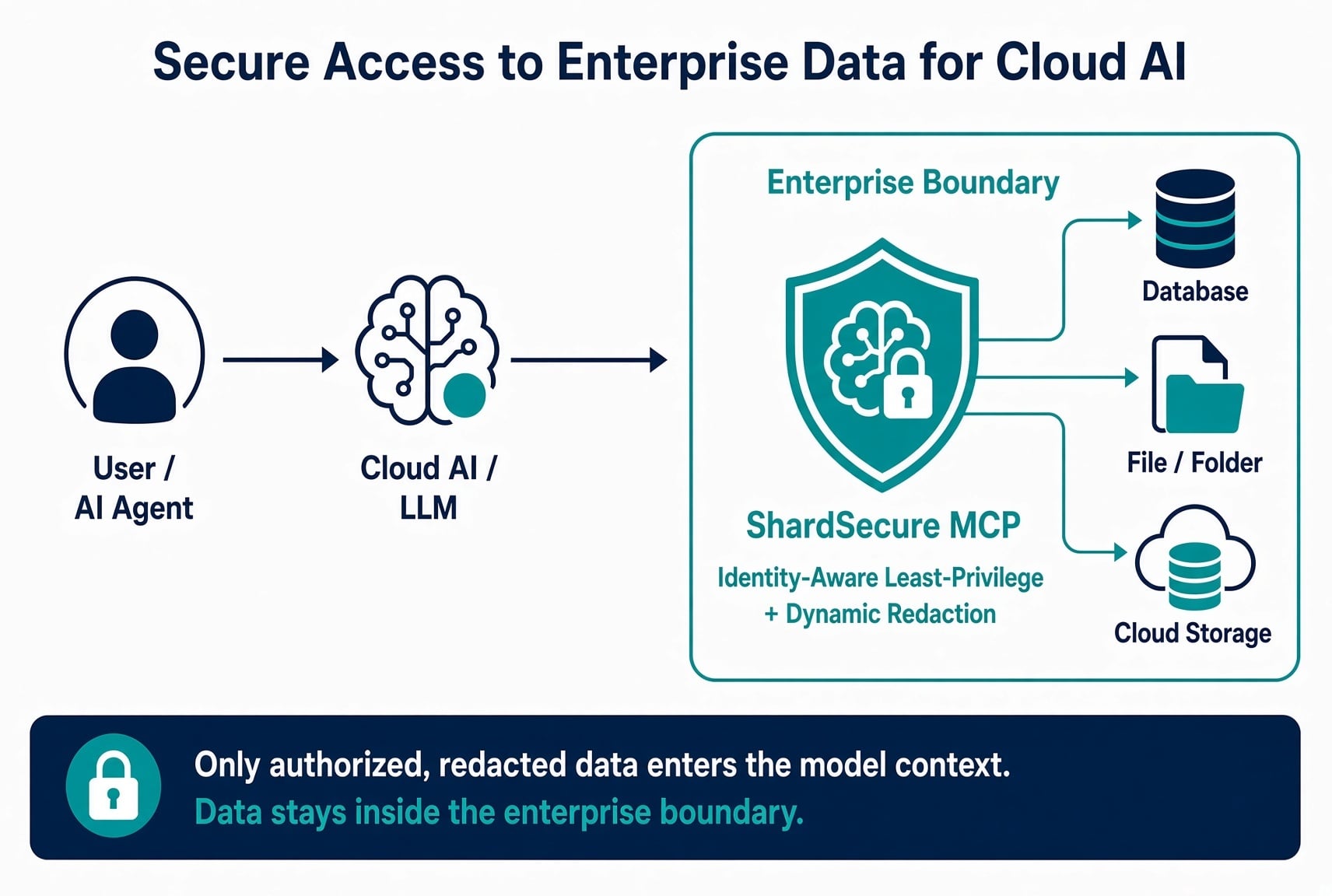
How It Works
- A user or AI agent issues a request through a cloud AI model or agent framework.
- The request reaches ShardSecure MCP inside the enterprise boundary.
- MCP evaluates the identity of both the user and the agent, applies policies, and retrieves only the allowed data fragments.
- Dynamic redaction is applied as needed (placeholders, masking, last-four characters, consistent synthetic mapping, and more).
- Only the sanitized, minimum necessary context is returned to the model.
Because the MCP sits next to the actual data sources—databases, file shares, object storage—it can make precise, least-privilege decisions at retrieval time. Rich metadata further reduces the volume of data that must be returned.
Example Use Cases
- Customer support agents — An AI assistant answers questions using internal knowledge bases and CRM records, but never sees full payment card numbers or private notes it is not authorized to access.
- Internal research copilots — Employees query company documents and databases through a cloud LLM. The model receives only the relevant, redacted excerpts allowed for that user’s role.
- Autonomous workflow agents — An agent that processes invoices or updates records pulls only the fields it needs from finance systems, with sensitive values masked before they enter the model context.
- Cross-border or regulated data access — Policies enforce data-sovereignty and classification rules so that AI running in the cloud never receives restricted data that must remain on-premises or in a specific region.
Key Benefits
- Data stays inside the boundary — No need to open broad firewalls or copy sensitive datasets into the cloud just for AI.
- True least privilege — Only the exact information required for the current task is provided.
- Identity-aware for people and agents — Policies understand both the human user and the AI agent making the request.
- Dynamic redaction — Sensitive values can be masked, truncated, or replaced before they ever reach the model.
- Simple integration — Works with existing cloud AI platforms and agent frameworks through the Model Context Protocol.
Why This Matters
As organizations move from simple chatbots to autonomous agents that retrieve and act on enterprise data, the risk of over-privilege and silent leakage grows. ShardSecure MCP closes that gap by enforcing zero-trust principles at the data source itself.
Cloud AI can finally use the data it needs—securely, with full control remaining inside the enterprise.
Evaluation / POC
ShardSecure MCP is available for no-cost evaluation by enterprise customers and partners. Contact us at info@shardsecure.com to schedule a technical briefing or proof-of-concept.
Ready to give cloud AI secure access to your data?
Contact info@shardsecure.com for a no-cost evaluation.